Show optional fields:
 ID Card Generator Online
Fill in your name, role, and organisation below — your card updates live as you type. When it looks right, hit Download or Print. That's all there is to it.
All cards are generated entirely in your browser — no data is sent to any server. Your details stay private on your own device.
Design a badge card or organisational pass using this free browser-based tool. This tool lets you add your name, photo, role, and organisation details. Download or print the finished card in PDF, PNG or JPG format. Note: Fields left blank will not appear on the printed card.
Disclaimer:
This ID Card Maker is for educational, organisational, and personal use only.
Cards created using this tool are design outputs only and must be used responsibly and lawfully.
Not affiliated: This is an independent website, not associated with any government body.
This is a free badge card maker that works entirely in your browser — no app to install, no account needed, nothing to pay. Students, teachers, hospital staff, event organisers, and small businesses use it to make clean, printable ID cards in minutes.
Most people find that making a card here is faster than explaining what they need to a designer. You type your details, see the result live, and download it — done.
Making a badge card here takes under two minutes. Here is what to do:
Step 1 — Type your details. Start with your name, ID number, and designation.
The card preview refreshes as you type — no button to press.
Step 2 — ID Number is optional. Leave it blank if you do not need it — the field simply disappears from the card.
Step 3 — Add a photo. Click the photo box on the live card to upload a picture from your device.
Step 4 — Adjust font and size. Use the font size slider and font family dropdown to match your style or institution's look.
Step 5 — Choose a card size. Pick from standard sizes — CR80, A4, passport, landscape — using the card size dropdown.
Step 6 — Download or print. Select PDF, PNG, or JPG and click Download. Or use Print to send directly to your printer.
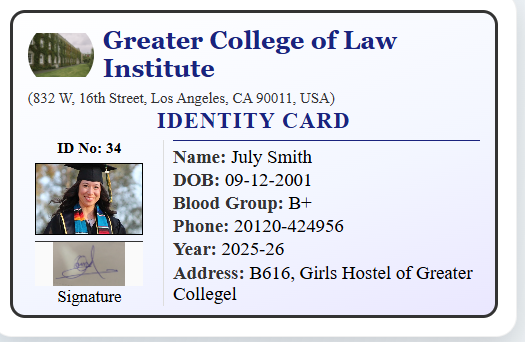
This tool is designed for anyone who needs a quick way to create a professional badge card without hiring a designer or using complicated software. It is useful for:
Schools and colleges can create student ID cards for daily use, examinations, library access and academic events. Students can create a badge card for campus events, library access or club membership.
Teachers, coaching centres, training institutes and tutors can instantly make their own badge cards or issue cards to their staff members.
Companies, shops, startups and private businesses can use this tool to generate employee badge cards for access control, attendance and workplace identification.
Medical staff, nursing assistants, interns and support teams can create neat and clear staff badge cards for professional use inside hospitals or clinics.
Organisers of seminars, exhibitions, workshops and conferences can prepare visitor, volunteer and organizer badges within minutes.
Freelancers, delivery partners, service providers, technicians and field workers can make simple and clean badge cards for professional identification.
Digital badge cards offer several advantages over traditionally printed cards. They are easy to generate, quick to update and provide better flexibility for both individuals and organisations. Some key benefits include:
Digital badge cards can be created within minutes. There is no need for complex software, graphic designers or long waiting times.
If a user changes their address, phone number, designation, or year, the digital badge card can be updated and regenerated instantly without printing delays.
You don’t need special equipment or high-cost printing services. Anyone can generate and print a card using a normal home printer. This free tool is provided by ID Card Generator Online.
The tool automatically aligns text, photos and fields properly, reducing chances of spelling mistakes or formatting errors.
Digital cards maintain consistent formatting and quality. The output looks clean and professional, Suitable for workplace, educational, event, and organisational use.
There is no wastage of cards, ink or plastic during repeated edits. Users print only the final corrected version.
Once designed, badge cards can be saved as PDF, shared digitally, or printed in bulk — ideal for events, teams and short-term visitors.
Digital cards can be saved as PDF, PNG or JPG and stored on mobile devices, email or cloud storage for future use.
A well-designed badge card includes key details that help identify the cardholder at a glance. Depending on the use case, the following fields are commonly included:
Including these details ensures your badge card looks professional and clearly identifies the cardholder.
A clean, well-structured badge card is easy to read and leaves a professional impression. Keep these points in mind:
A well-designed badge card improves recognition and gives a professional impression.
Badge cards come in several standard sizes. The most common is CR80, the same dimensions as a standard credit card.
Choosing the correct size ensures compatibility with printers and card holders.
This tool is developed to help students, professionals, and organisations design clean, printable badge cards — no design software needed.
Our goal is to provide a free, easy-to-use solution that works directly in your browser while maintaining privacy and simplicity.